
Diedorf: Feldatal History and Cycle Route
Accommodation in Diedorf
Diedorf brings together an early documentary mention, the history of the Feldatal and a cycle route that passes through the village. This offers different focal points for planning your trip: local history, cycling and the surrounding landscape. Dermbach adds a distinct regional focus for further cultural and nature-related topics.
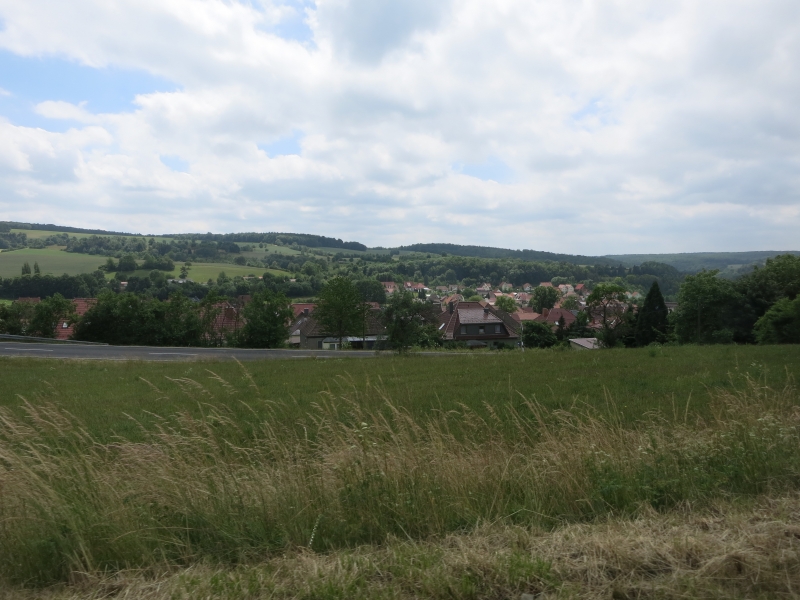
Diedorf’s history and the narrow-gauge railway
Diedorf was first mentioned in a document on 17 February 778, under the name Diodorphono. Centuries later, the expansion of the narrow-gauge railway brought prosperity to Diedorf and the entire Feldatal. The first train ran on the route from Dorndorf to Kaltennordheim on 22 June 1880; in 1934, the line was converted to standard gauge. Diedorf’s history thus brings together an early written record and a later transformation in transport.
Cycle route and surrounding landscape
The Feldatal cycle route passes through Diedorf and Fischbach. If you would like to include Diedorf in a cycling tour, the route provides a specific link; check current route information before setting off. In the area around Diedorf, Kuhkopf is an example of dry and semi-dry grassland, partly characterised by centuries-old pollarded beech trees. This combination of grassland and old trees offers a different focus from the history of the village and its transport.
Cultural history in Dermbach
In Dermbach, the Museum of the Thuringian Rhön showcases traditional crafts such as weaving and carving, as well as historical tools, traditional costumes, furniture, agricultural equipment and handicrafts. Its main themes include the history of the Dermbach administrative district and the Peasants’ War in the Vorder Rhön. Other topics include cork processing in Dermbach, small industrial businesses along the Feldabahn, built in 1880, the narrow-gauge railway itself, the legend of Rhönpaulus, and the 1866 clashes between Prussia and Bavaria in the Dermbach area.
Dermbach’s architectural history also spans different periods. Dermbach Castle was built in 1707 by Adalbert von Schleifras, Prince-Abbot of Fulda. Three simple Baroque-style buildings enclose a spacious rectangular courtyard. The Protestant church on Kirchberg is dedicated to the Holy Trinity and was built in 1714 on the foundations of an earlier church in the Peasants’ Baroque style. Dermbach is also home to the smallest half-timbered church in South Thuringia, dating from 1677. The Catholic parish office is housed in a former Franciscan monastery built in 1730/31. The Old Cemetery is now a small park-like area.
Nature and route options in Dermbach
The Ibengarten yew forest lies above Glattbach, a district of Dermbach. The Rhönpaulus-Wald Ibengarten Experience Trail is seven kilometres long from Dermbach and two kilometres long from Glattbach, each way. The return route follows the same path down Neuberg. These two distances give you a concrete basis for comparing route options.
Another nature highlight is the greater mouse-eared bat: for decades, the attic of the church in Neidhartshausen has been home to a maternity roost. The protected roost was included in the European Natura 2000 network as a Flora-Fauna-Habitat site in 2008. The bat trail leads from Neidhartshausen to Zella, a district of Dermbach.
Then tailor your search to your preferred destination.
Discover more destinations
Discover more destinations: Zella, Nazza, Mihla, Frankenroda, Tiefenort, Eisenach, Bad Liebenstein, Urnshausen.
Back to the overview of the wider region: Wartburg.
