
Discover Niederdorla
Accommodation in Niederdorla
In Niederdorla, village history and distinctive landmarks are close together: a half-timbered house dating from 1780, a surviving village gate and the geographical centre of Germany all feature in local discoveries. To the north of the village, Opfermoor Vogtei adds an exhibition building and open-air grounds, offering a glimpse into the distant past of religious beliefs and settlement history. You can choose between historical sites in the village and archaeological insights in the surrounding area.
Village history brought to life at specific sites
The half-timbered house at Sperlingsstraße 17 was built in 1780 and is well preserved. The Deutschordenritterhaus at Herrenstraße 2 is also well preserved. Fickentor offers a different perspective: it is one of the last surviving village gates in Thuringia. The village green is another of Niederdorla’s sights. Together, these places take you through different chapters of the village’s history, which is not limited to a single era.
St. John’s Church was rebuilt in 1772 after a fire. The building thus marks a specific event in the village’s history. Residents keep traditional customs alive at Pentecost and during the church fair.
The geographical centre of Germany and village life
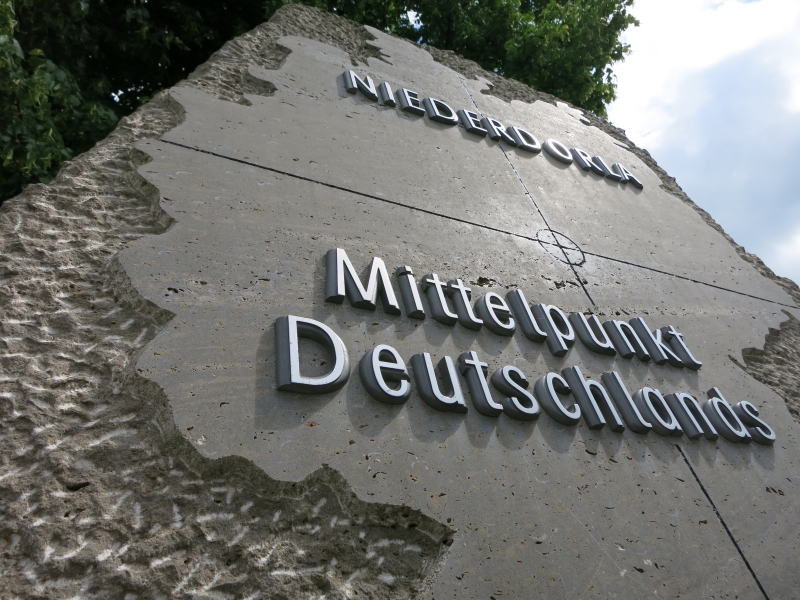
The geographical centre of Germany was determined on the outskirts of Niederdorla in October 1990. An imperial lime tree was planted there in February 1991. A festival is held at the centre every year. This site combines a documented geographical point with a distinctive tree and an annual tradition. The village green and Fickentor offer different points of interest: they tell you about the layout of the village and a surviving gate, rather than the same occasion.
Relaxation and fishing nearby
The Seebach reservoir near Niederdorla is a designated fishing area and a local recreation area. This offers another theme for planning your trip alongside the historical sights: fishing and relaxation by the water. A reservoir south of Niederdorla also serves as a recreation area.
Opfermoor Vogtei: archaeology in the open air
Opfermoor Vogtei lies north of Niederdorla. In the exhibition building and the adjoining open-air grounds, visitors can learn about the way of life and beliefs of the ancestors who settled here. The period represented spans from the 6th century BC to the 6th century AD. The small museum displays original finds from archaeological excavations of the settlement and the ritual site. Numerous shrines discovered during excavations lasting several years are also on display in the “Opfermoor” exhibition building.
The grounds include reconstructed houses from a Germanic settlement dating to the 3rd century AD. Since 1991, ritual sites and parts of a nearby settlement have been reconstructed here, based on excavations by Prof. Behm-Blancke. Finds and offerings from the area date back to 600 BC and span a period of about 1,000 years. Guided visits to Opfermoor Vogtei for groups are limited to a maximum of 25 people.
More cultural sites in the Vogtei
The Vogtei, the wider travel destination, also offers a range of cultural experiences. In Oberdorla, the Romanesque collegiate church of St. Peter and Paul is worth a visit; its portal features two heavily weathered but impressive depictions of apostles. The Oberdorla local history room focuses on village life, local and church history, and Vogtland customs. The Unstrut-Werra Cycle Route also passes through Oberdorla. These places and themes are part of the Vogtei and complement Niederdorla’s own sights with more ways to explore the region.
If you are looking for accommodation in Niederdorla, it is best to make your choice based on what you want to focus on during your stay: Would you like to immerse yourself in village history, visit nearby Opfermoor, or also make time for the Vogtei’s cultural sites? Your answer can help you find the right base for your interests.
Discover more destinations: Bad Langensalza, Großvargula, Menteroda, Oppershausen, Obermehler, Unstruttal, Anrode, Weberstedt.
See the overview of the wider travel region: Unstrut-Hainich.
